DIY Tree Care Mistakes to Avoid: When to Call the Professionals
Table of Contents
- Introduction
- Which Tree Care Tasks Are Reasonable for Homeowners?
- DIY Tree Care Mistakes That Can Damage Trees or Property
- When Tree Pruning Should Be Left to a Professional
- When Tree Removal Is Too Risky for DIY
- Why Stump Grinding Is Often Better Than DIY Removal
- What Homeowners Commonly Get Wrong About Tree Care
- What Works, What Fails, and What Professionals Do Differently
- A Practical DIY vs. Professional Tree Care Decision Guide
- Conclusion
- Professional Tree Care in Stroudsburg and the Poconos
- Frequently Asked Questions
Key Takeaways
- DIY tree care can make sense for simple, ground-level maintenance, but larger jobs require a different level of training and equipment.
- Over-pruning, improper cuts, unsafe ladder use, and attempting to remove large trees are among the biggest DIY mistakes.
- Trees near homes, vehicles, roads, or utility lines require extra caution because a small cutting error can create substantial property or safety risks.
- Stump grinding is not the same as digging out a stump; professional equipment can remove the visible obstruction with less disruption to the surrounding yard.
- McIntyre's Tree Service provides tree removal, tree trimming and pruning, stump grinding, land clearing, and other professional tree services around Stroudsburg and surrounding communities.
Introduction
The safest approach to DIY tree care is knowing which jobs you can handle from the ground and which ones require professional equipment, planning, and experience. Picking up small fallen branches or monitoring a tree's condition may be reasonable for a homeowner, while removing a large limb, climbing a tree, or taking down a mature tree can quickly become hazardous.
Professional tree care services including removal, trimming and pruning, stump grinding, and land clearing, giving homeowners a way to address jobs that go beyond routine yard maintenance. The company says its team includes certified arborists and uses specialized equipment for tree work.
The point isn't that homeowners should never work around their own trees. Rather, good tree care starts with recognizing the difference between routine maintenance and hazardous tree work.
Which Tree Care Tasks Are Reasonable for Homeowners?
Not every tree-related job requires a professional.
Depending on the circumstances, homeowners can generally handle basic tasks such as:
- Removing small branches that have already fallen to the ground
- Keeping leaves and debris away from the base of trees
- Monitoring trees for visible changes
- Watering trees appropriately during dry periods
- Maintaining reasonable mulch around the root zone
- Looking for obvious dead, broken, or damaged branches
- Checking trees after storms from a safe location
The important distinction is whether the work can be performed safely without climbing, using a chainsaw at height, handling heavy limbs, or putting yourself underneath an unstable tree.
McIntyre's homeowner-focused information also emphasizes proactive maintenance and knowing when tree conditions call for professional attention.
If a task requires you to leave the ground or control a large piece of falling wood, the risk changes substantially.
DIY Tree Care Mistakes That Can Damage Trees or Property
1. Over-Pruning the Tree
One of the easiest mistakes to make is assuming that removing more branches will automatically make a tree healthier.
It won't.
Removing too much live growth can place unnecessary stress on a tree and alter its natural structure. Pruning should have a specific reason rather than becoming a process of cutting every branch that looks inconvenient.
A better question is:
What problem am I trying to solve by removing this branch?
If you can't answer that clearly, don't make the cut.
2. Cutting Branches Without Understanding Their Weight
A branch can look manageable while still carrying considerable weight.
Once cut, that weight can shift unexpectedly. The branch may swing, split, roll, or fall in a direction that isn't obvious from the ground.
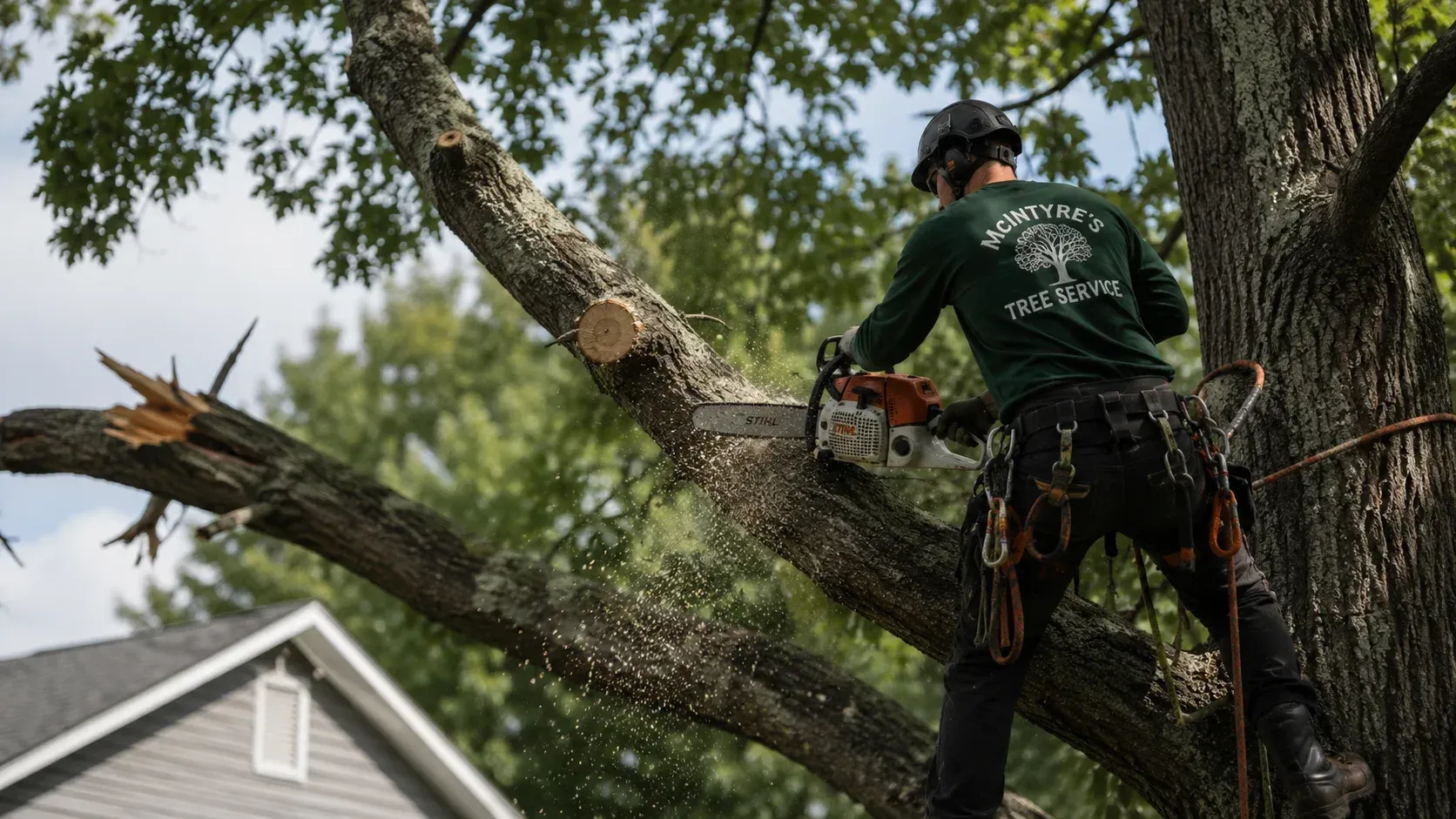
This is one reason professional pruning involves more than simply knowing how to operate a saw. McIntyre's Tree Service says its trimming and pruning work focuses on maintaining tree shape, structure, and health.
3. Using a Ladder for High Branches
A ladder may seem like a convenient way to reach a branch, but tree branches move.
If the branch shifts while you're cutting, your balance, the ladder, and the cutting tool can all become hazards at the same time.
If a branch is too high to reach safely from the ground, that's a strong signal to stop the DIY project rather than improvising with a ladder.
4. Cutting Without Considering the Fall Zone
Before a tree or major limb comes down, you need to consider everything that could be affected:
- Your home
- Vehicles
- Fences
- Landscaping
- Neighboring property
- Walkways
- Roads
- Utility infrastructure
A tree doesn't have to be enormous to cause expensive damage.
McIntyre's tree removal service specifically addresses projects involving trees of different sizes and emphasizes safety and minimizing impact on surrounding property.
5. Attempting to Remove a Large or Damaged Tree
A dead, leaning, split, or storm-damaged tree shouldn't be treated like an ordinary cutting project.
The condition that made the tree hazardous can also make it unpredictable.
McIntyre's information on tree removal notes that its team assesses the project and uses appropriate equipment and safety procedures based on factors such as tree size, location, and nearby structures.
6. Trying to Dig Out a Large Stump by Hand
A stump's visible portion is only part of the problem.
Large roots can extend through the surrounding soil, making manual excavation slow, disruptive, and physically demanding. Professional stump grinding offers another approach by grinding the stump below ground level rather than excavating the entire root system.
When Tree Pruning Should Be Left to a Professional
Tree pruning becomes a professional-level job when the branches are:
- Large or heavy
- High above the ground
- Close to a roof
- Near power lines
- Over a driveway or road
- Partially broken
- Attached to a declining tree
- Located above an area where people regularly walk or park
The goal of pruning should be to improve the tree's structure or address a specific concern, not simply to make the tree smaller.
McIntyre's service information describes its pruning approach as precision trimming intended to support healthy growth and structural integrity.
For homeowners, the practical rule is simple:
If you cannot safely reach the branch from the ground, don't turn the project into a climbing or ladder job.
When Tree Removal Is Too Risky for DIY
Tree removal is one of the clearest examples of where DIY enthusiasm can become dangerous.
Professional assistance is particularly important when a tree:
- Is large or mature
- Has a significant lean
- Is dead or structurally compromised
- Has split or broken limbs
- Is close to a house or garage
- Is near utility lines
- Could fall toward a road or neighboring property
- Has been damaged by severe weather
- Cannot be safely accessed from the ground
A storm-damaged tree deserves additional caution because broken limbs may be under tension and the tree's balance may have changed.
McIntyre's service-area information specifically describes its removal work as designed to safely handle unwanted or hazardous trees while protecting surrounding property.
One of the worst DIY assumptions is that a tree becomes safer once you've already started cutting it. An improperly cut tree can become more unstable, not less.
Why Stump Grinding Is Often Better Than DIY Removal
Tree removal doesn't always mean the job is completely finished.
The remaining stump can become:
- A trip hazard
- An obstacle for lawn equipment
- A source of unwanted growth
- A problem for future landscaping
- A place where insects and fungi establish themselves
- An obstruction when reclaiming usable yard space
Professional stump grinding addresses the visible stump without requiring homeowners to excavate the entire root system.
McIntyre's published information explains that grinding can be less invasive and faster than full stump extraction, while leaving the remaining roots to decay naturally.
There is also a pest-control consideration. Decaying stumps can provide moisture, shelter, and food for insects, which is why removing old stumps can help reduce conditions that attract pests.
For homeowners planning a new garden, lawn, patio, or other landscape improvement, dealing with the stump sooner can also make the next project easier.
What Homeowners Commonly Get Wrong About Tree Care
Generic DIY advice often focuses on how to perform a cut.
The more important question is:
Should you be making that cut yourself in the first place?
Before starting any tree project, consider seven factors:
Height
Can you perform the entire job safely from the ground?
Branch Size
What happens if the branch weighs more than expected or moves unexpectedly?
Tree Condition
Is the tree healthy, dead, cracked, leaning, or storm damaged?
Location
What is underneath the branch or tree?
Equipment
Do you have the right equipment and the training to use it safely?
Utilities
Are electrical or other utility lines nearby?
Consequences
If the cut goes wrong, what can it hit?
If several answers raise concerns, professional tree care is the more sensible choice.
What Works, What Fails, and What Professionals Do Differently
What works: early observation
One of the most useful things a homeowner can do is inspect trees regularly from a safe location.
Look for:
- Dead branches
- Major cracks
- Unusual leaning
- Broken limbs
- Changes in foliage
- Storm damage
- Branches growing toward structures
Identifying a concern early gives you more time to make a controlled decision rather than waiting for an emergency.
What fails: treating every tree like the same project
A small ornamental tree and a mature tree beside a house are completely different jobs.
The same cutting method should not automatically be applied to both.
What professionals do differently
Professionals start by assessing the tree and the surrounding property before deciding how the work should be performed.
McIntyre's Tree Service says its removal and pruning work begins with site assessment, hazard identification, safety planning, appropriate equipment, and coordination among the crew.
That assessment is often the part homeowners don't see, but it can be the most important part of the job.
What we would never recommend
We would never recommend that an inexperienced homeowner attempt to remove a large tree simply because they own a chainsaw.
We also would not recommend:
- Cutting a tree near energized utility lines
- Climbing a tree to reach a difficult branch
- Standing beneath a limb while cutting it
- Attempting to control a severely storm-damaged tree without professional assistance
- Removing a large stump with improvised equipment
The potential cost of a mistake can outweigh the money saved by attempting the work yourself.
A Practical DIY vs. Professional Tree Care Decision Guide
The deciding factor isn't simply whether you can physically complete a task. It's whether you can complete it without creating an unacceptable risk to yourself, your property, the tree, or someone nearby.
Conclusion
Responsible DIY tree care isn't about doing every job yourself. It's about understanding where routine maintenance ends and specialized tree work begins.
Homeowners can play an important role by monitoring their trees, maintaining their yards, noticing warning signs, and addressing concerns early. But large-scale pruning, hazardous tree removal, storm-damaged trees, and stump grinding are different types of work that may require professional equipment, planning, and experience.
For homeowners around Stroudsburg, Saylorsburg, Allentown, Easton, and Monroe and Lehigh counties, McIntyre's Tree Service provides professional tree removal, trimming and pruning, stump grinding, land clearing, and related services.
Professional Tree Care in Stroudsburg and the Poconos
If you're unsure whether a tree project is safe to handle yourself, getting a professional assessment before making the first cut can prevent a much larger problem. McIntyre's Tree Service offers free estimates and professional tree care for residential and commercial properties throughout its service area.
You can
contact us to discuss your tree care needs and determine the safest approach for your property.
Frequently Asked Question
What tree care can homeowners safely do themselves?
Low-risk, ground-level tasks such as removing small fallen branches, maintaining the area around trees, and monitoring tree condition are generally more appropriate for DIY work. Large cutting, climbing, and removal projects are better evaluated by professionals.
When should I call a professional tree service?
Consider professional help when a tree is large, leaning, damaged, close to a structure or utility line, or requires climbing, heavy cutting, specialized equipment, or complicated removal.
Is DIY tree pruning safe?
Simple ground-level pruning may be possible in some circumstances, but large or elevated branches can present significant risks. Poor pruning can also affect tree structure and health, so complex pruning is better handled by trained professionals.
Is stump grinding the same as stump removal?
No. Stump grinding uses specialized equipment to grind the visible stump below ground level, while full stump removal involves extracting the stump and a larger portion of its root system. McIntyre's information notes that grinding is generally less invasive than full extraction.
Does McIntyre's Tree Service handle emergency tree work?
Yes. McIntyre's website states that emergency services are available year-round, including 24/7 emergency service for urgent tree care needs.
Related Posts