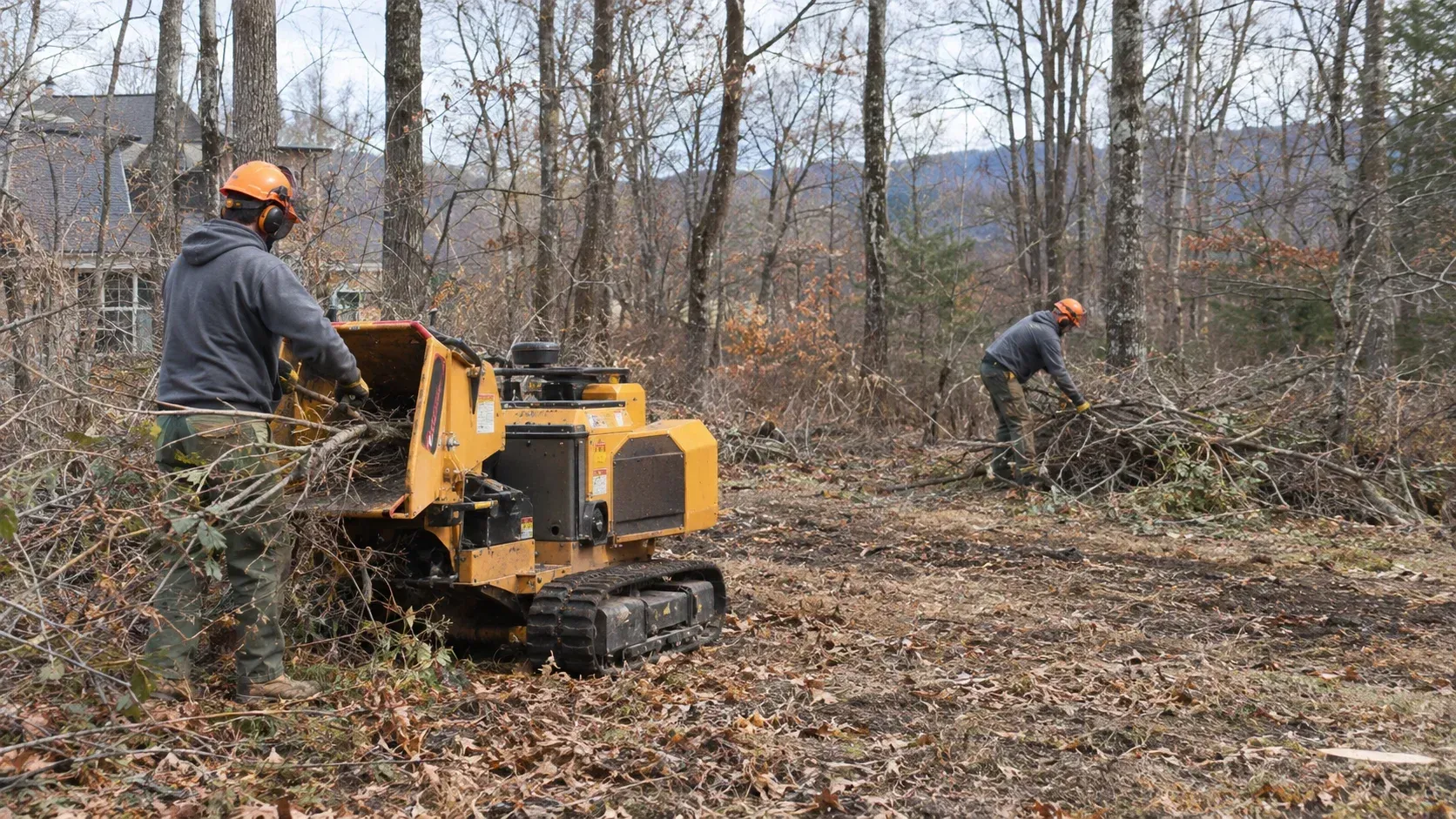
Do You Need a Permit for Land Clearing in the Poconos?

Table of Contents
- Do You Need a Permit to Clear Land in the Poconos?
- What a Land Clearing Permit Actually Covers
- Common Triggers That Require a Permit
- How Local Rules Are Structured in Monroe County
- A Framework for Figuring Out If You Need a Permit
- What the Permit Process Typically Involves
- Conclusion
- Have Questions About a Land Clearing Project Near Stroudsburg, PA?
- Frequently Asked Questions
Key Takeaways
- Whether you need a land clearing permit in the Poconos depends on your specific township, the size of the project, and site conditions like wetlands, steep slopes, and stormwater.
- Small residential clearing on flat, dry ground often needs little or no permitting, while larger or environmentally sensitive projects usually do.
- Wetlands, streams, steep slopes, and erosion control are the most common triggers for local and state review.
- Rules are set at the municipal and county level and vary between townships, so the only reliable answer comes from your own municipal office.
- Clearing without required approvals can lead to fines, stop work orders, and costly restoration, which makes checking first far cheaper than fixing it later.
Introduction
Whether you need a permit for land clearing in the Poconos depends on where your property sits and what the project involves, since rules are set by individual townships and Monroe County rather than a single statewide standard. Small clearing on flat, dry ground often requires little or no permitting, while larger projects or work near wetlands, streams, or steep slopes usually triggers local review. Before any land clearing work begins, the safest first step is confirming the requirements with your municipal office.
This matters because getting it wrong is expensive. Clearing without a required permit can bring fines, a stop work order, and orders to restore what was removed, which can cost far more than the clearing itself. For homeowners and landowners around Stroudsburg planning a driveway, a building site, a garden, or a cleared view, understanding the permit question early keeps a straightforward project from turning into a legal and financial headache. This guide explains what usually requires a permit, what usually does not, and how to confirm the answer for your own land.
Do You Need a Permit to Clear Land in the Poconos?
Sometimes. A land clearing permit is often required for larger projects or for clearing near wetlands, waterways, or steep slopes, but small residential clearing on unregulated ground frequently does not need one. The requirement depends on your township and site.
There is no single Poconos-wide rule. Pennsylvania regulates certain environmental activities at the state level, counties add their own layer, and each township sets its own zoning and land use ordinances. That means two neighbors in different townships can face different requirements for the same kind of work.
Because of this patchwork, the honest answer to "do I need a permit" is always "check with your municipality first." Any general guide, including this one, can tell you what commonly triggers a permit, but only your local office can confirm what applies to your parcel.
What a Land Clearing Permit Actually Covers
A land clearing permit is a local government's approval to remove trees, brush, and vegetation from a property, usually tied to concerns about drainage, erosion, and environmental impact rather than the trees themselves.
The purpose is rarely to stop you from clearing. It is to make sure the clearing does not cause problems downstream, literally. Removing vegetation changes how water moves across and off a property, and unmanaged runoff can erode soil, flood neighbors, and carry sediment into streams.
Related Approvals You Might Encounter
A clearing permit is sometimes just one piece. Depending on the project, you may also deal with grading permits, stormwater management plans, erosion and sediment control plans, driveway permits, or wetland approvals. Larger projects tend to involve more of these, which is why scope matters so much to the answer. The clearing work itself may also pair with follow up tasks like stump grinding once the trees are down.
Common Triggers That Require a Permit
The most common triggers for a land clearing permit in the Poconos are project size, wetlands or waterways, steep slopes, and the total area of soil disturbance.
Certain site conditions reliably move a project from "probably fine" into "needs review." Knowing them helps you predict the answer before you call.
Wetlands and streams. Clearing near wetlands, streams, ponds, or floodplains commonly triggers both local and state oversight, since these areas are environmentally protected.
Steep slopes. Many Pocono townships have steep slope ordinances, because clearing on a grade sharply increases erosion and runoff risk. Slope is one of the more common reasons a project needs approval here.
Area of disturbance. Once a project disturbs a certain amount of earth, state erosion and sediment control rules generally apply. Pennsylvania has thresholds for when a formal control plan is required, and larger clearings routinely cross them.
Stormwater impact. Projects that noticeably change drainage may require a stormwater management plan showing where the water will go after clearing.
How Local Rules Are Structured in Monroe County
Understanding who sets the rules helps you know whom to ask. Land clearing oversight in the Poconos generally comes from three levels.
State level. Pennsylvania's Department of Environmental Protection oversees erosion and sediment control and activities affecting wetlands and waterways once certain thresholds are met.
County level. Monroe County and its conservation district play a role in erosion, sediment, and stormwater review, particularly for larger projects.
Township level. Individual municipalities set zoning, steep slope, tree, and land use ordinances. This is where the most variation lives, and where most homeowners start.
Why This Layering Matters
A project can be fine at one level and regulated at another. You might clear a small area with no township permit needed, yet still fall under state erosion rules if you disturb enough soil. Checking a single office is not always enough for a larger job, and your township can usually point you to the other agencies that apply.
A Framework for Figuring Out If You Need a Permit
You can often predict the likely answer before making a single call. Work through these factors in order, since each one raises the odds that a permit is involved.
| Factor | Lower Permit Likelihood | Higher Permit Likelihood |
|---|---|---|
| Project size | Small area, few trees | Large area, acres cleared |
| Terrain | Flat, stable ground | Steep slopes |
| Water features | None nearby | Wetlands, streams, floodplain |
| Soil disturbance | Minimal grading | Significant earthmoving |
| Purpose | Light cleanup | Building site or development |
The pattern is straightforward. The bigger the project, the steeper the ground, and the closer to water, the more likely you need approval. A homeowner clearing brush along a flat back fence is in very different territory than someone clearing an acre of sloped, wooded ground for a new home.
This framework does not replace a call to your township. It tells you how prepared to be for that call, and whether to expect a simple answer or a longer process.
What the Permit Process Typically Involves
When a permit is required, the process usually involves an application, a site plan, and sometimes an inspection, with timelines and fees that vary by municipality.
The specifics differ everywhere, but the general shape is consistent. You contact the municipal office, describe the project, and learn what applies. If a permit is needed, you submit an application, often with a sketch or plan showing what will be cleared and how drainage and erosion will be handled. Knowing the full range of tree and clearing services your project needs also helps you describe the scope accurately.
Fees are usually modest for straightforward residential permits, though larger projects requiring engineered plans cost more. Timelines range from quick approvals to several weeks for projects needing county or state review. Starting early, well before you want work to begin, prevents the permit from becoming the bottleneck.
Where a Tree Service Fits In
Established local tree and clearing companies deal with these situations regularly and often know the general lay of the land in nearby townships. While the property owner is typically responsible for permits, an experienced team that handles brush removal and full clearing can help you understand what your project may involve before you commit.
Conclusion
Whether you need a permit for land clearing in the Poconos comes down to your specific township, the size of the project, and site conditions like slope, soil disturbance, and nearby water. Small clearing on flat, dry, unregulated ground often needs little. Larger projects, steep terrain, and anything near wetlands or streams frequently require local and sometimes state and county approval.
The dependable path is to check before you cut. Use project size, terrain, and water features to gauge how involved the process is likely to be, then confirm with your municipal office and any agencies they point you toward. That order of operations, question first and clearing second, protects your budget, your timeline, and your relationship with the land around you.
Have Questions About a Land Clearing Project Near Stroudsburg, PA?
If you are planning to clear land in the Poconos and want to understand what your project may involve before you start, talking it through with an experienced local team is a low pressure first step. Permit responsibility generally rests with the property owner, but a knowledgeable provider can help you think through scope, site conditions, and what to confirm with your township. You can
contact McIntyre's Tree Service or call (610) 762-0660 to ask questions and plan your next move.
Frequently Asked Questions
Do I always need a permit to clear land in the Poconos?
No. Small clearing on flat, dry ground often needs little or no permitting, while larger projects or clearing near wetlands, streams, or steep slopes usually requires review. The requirement depends on your township and site, so confirm locally before starting.
Who do I contact to find out if I need a permit?
Start with your township or municipal office, which handles local zoning and land use rules. For larger projects, they can direct you to the Monroe County Conservation District and Pennsylvania DEP, which oversee erosion, stormwater, and wetland matters.
Does clearing near a stream or wetland require special approval?
Usually, yes. Wetlands, streams, ponds, and floodplains are environmentally protected, and clearing near them commonly triggers both local and state oversight. These are among the most reliable reasons a project needs formal review before work begins.
What happens if I clear land without a required permit?
Possible consequences include fines, a stop work order, and being required to restore the cleared area. Restoration can cost significantly more than the original clearing, which is why confirming requirements beforehand is the safer and cheaper path
Is the tree service or the property owner responsible for permits?
Responsibility typically rests with the property owner, though a reputable contractor will usually raise the permit question. It is best to confirm requirements yourself rather than assume the clearing company has handled all approvals.
Related Posts